

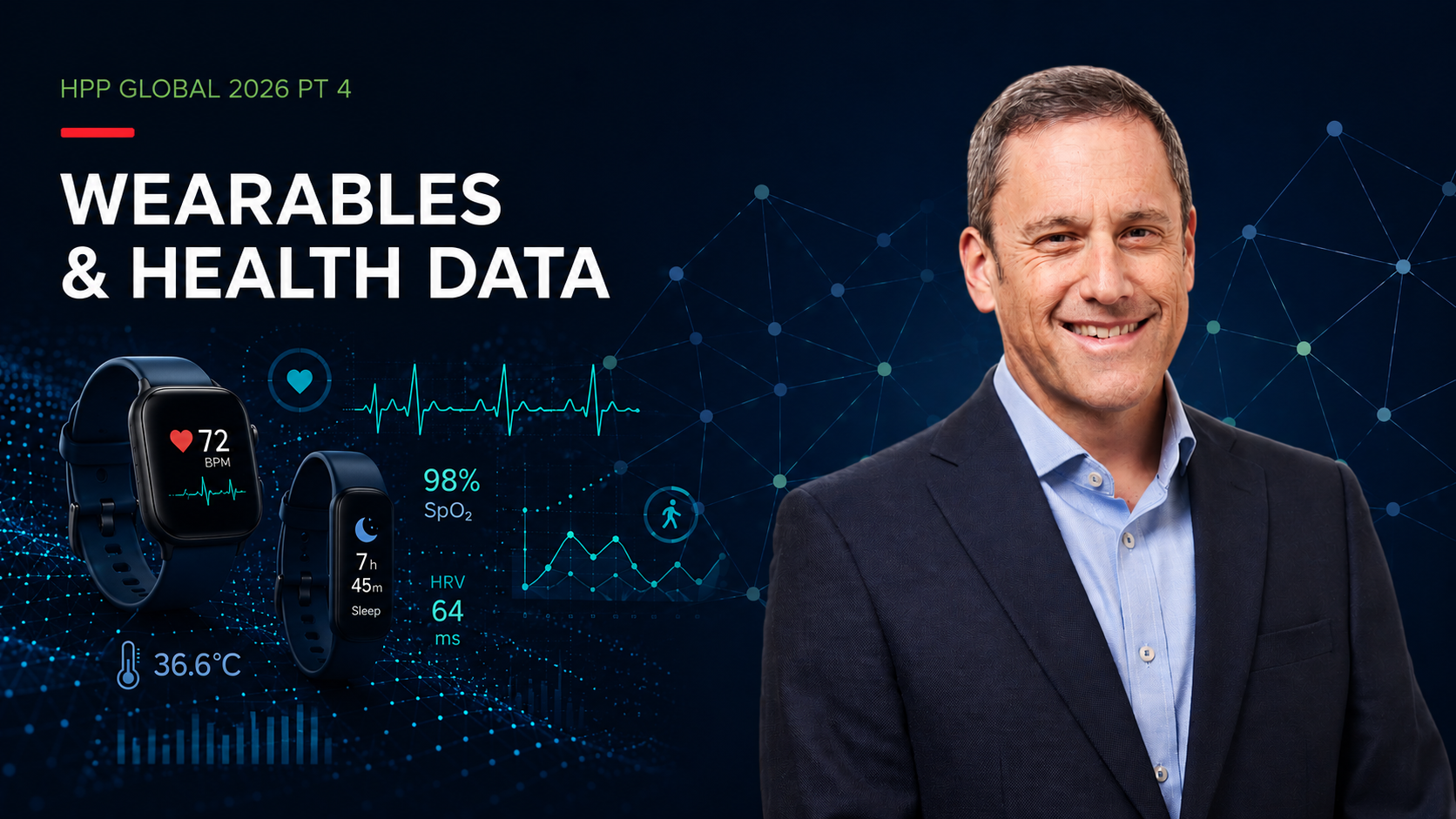
A Q&A with Josh Schulman, PhD, Managing Partner and CSO of Corundum Neuroscience
By Henry Haiser, PhD, Corundum Systems Biology
At the recent HPP Global 2026 conference in Abu Dhabi, organized by Nature Conferences, one recurring theme was the role of wearable technology in reshaping how we collect health data and, increasingly, how we predict health events. Studies presented described a shift in breadth and quantities of data in longitudinal studies, as well as examples of new capabilities such as detecting pregnancy days after conception, flagging COVID symptoms before patients felt sick, and outperforming traditional clinical trial endpoints in rare diseases. I sat down with Josh Schulman, Managing Partner and Chief Scientific Officer of Corundum Neuroscience, to unpack what we saw and discuss why it matters.
HH: Josh, wearables came up in several different contexts at the conference. What was the big picture that emerged for you?
JS: An overarching message was that wearables are moving from fitness tools to instruments for data collection at scale and proactive health forecasting. Traditional studies have typically been limited to periodic measurements using tools designed for clinical diagnosis or monitoring. People would come to a hospital or clinic, undergo a series of tests, and these results would generate a snapshot of a particular aspect of their health state. But we are beginning to see that signs of disease may appear much earlier and be different from what those single-timepoint views are designed to detect. Wearables are starting to capture signals of the transition from health to disease, which is a fundamentally different proposition than traditional clinical measurements or tracking your morning run.
HH: Can you walk us through some concrete examples from the talks at the conference?
JS: Shyamal Patel from Oura Health presented three large studies using Oura Ring data. The first, with the National University of Singapore, analyzed 220,000 users across 35 countries, covering 50 million nights of sleep.1 The researchers found that socio-cultural factors drive important differences in sleep behavior. As a group, users in Asia had shorter nighttime sleep with higher variability in the number of hours slept while users in Europe and the US had longer weekend sleep. These population-scale patterns are much more difficult to uncover with traditional survey methods where each datapoint requires a subject to report individually and usually not as often.
A second study tracked physiological responses to COVID-19 vaccination in over 20,000 users. By tracking physiological responses such as breathing rate, heart rate variability, temperature, and sleep patterns, Oura’s scientists were able to track response to infection. They saw that infection responses following vaccination were smaller and returned to normal ranges faster in vaccinated individuals, with stronger effects in people who received more than one vaccine. They also saw that vaccination in younger adults had a stronger effect on these physiological measures than in older adults.2 Perhaps the most striking observation was that physiological signs of infection were detectable more than two days before people reported symptoms.3
A third study out of UCSD showed pregnancy detection 5.5 days after conception using body temperature changes.4 That is about nine days before a standard at-home test could detect. In all these cases, Dr. Patel showed how consumer wearables that require little effort on the part of the user can detect important physiological signals earlier and more easily than molecular or biochemical tests can.
HH: The Oura Ring example operates at a consumer scale. What did we hear about wearable use in clinical settings?
JS: One example that stood out was a presentation by Laurent Servais from the University of Oxford, who presented his team’s work on a purpose-built wearable sensor for clinical trials of rare neuromuscular diseases. To explain the need for this type of device in his research, Prof. Servais described the “Eiffel Tower paradox”: traditional endpoints like the Six-Minute Walking Test,5 which measures exercise capacity, may not always be reliable because, in rare disease studies in particular, patients often travel long distances to testing sites and their performance on any given day depends on external factors. In the case of his research, he noted that a child with Duchenne muscular dystrophy visiting a clinic in Paris might have spent the previous day sightseeing and arrive at the clinic already fatigued, which would cause a treatment to look less effective than it is at the muscular level.
To develop a more complete picture of movement in his patients, Servais’ team built clinical-grade sensors that reconstruct every stride and stair movement during normal daily life. The resulting measure, SV95C, became the first wearable-derived outcome qualified by the European Medicines Agency as a primary endpoint.6 It has since been adopted across multiple medical conditions. One example of the critical role of this type of measurement was a gene therapy trial led by Solid Biosciences, where the traditional primary endpoint measurement showed no treatment effect, while SV95C revealed a significant response. In this case, the drug being tested would have been declared a failure under the old measurement paradigm.
HH: There is an obvious tension between the data quality you get from clinical-grade devices and the scale you get from consumer wearables. Did the speakers address that trade-off?
JS: That was a recurring theme. Sleep tracking is a good example. Until recently, the alternatives were either self-reporting and its intrinsic limitations or running a study in sleep labs in a clinic or hospital. Sleep lab data provides higher signal quality but traditionally requires a near-medusa of wires and sensors on the head and body, and sleeping away from home, both of which can impact the quality of sleep. Cost and logistics also dictate that only a small number of nights are measured, and most of the historical data collected is from people for whom there is at least a suspicion of disease.
On the other hand, data collected by consumer wearable devices typically has lower resolution but has the advantage of allowing consecutive nights to be unobtrusively collected from multiple people sleeping in their natural environments. So, while the resolution is lower at the level of a single time point for an individual, the improvement in ecological validity and scale can help identify signals.
Another speaker at the event, Prof. Ruth Loos from the University of Copenhagen, presented a compelling middle ground with the DELPHI cohort, a structured longitudinal study which layers multiple wearables simultaneously: continuous glucose monitors, smartwatches, and silicone wristbands for sweat metabolomics. The goal is to cover as many physiological dimensions as possible while people go about their normal lives. One important point that Professors Servais and Loos made was that these types of studies need to account for the unique features of the population being measured. For this reason, the DELPHI study, which is running in Denmark, where bicycle riding is common, included thigh-mounted accelerometers to capture that activity.
HH: Looking ahead, how do you think wearables will integrate into healthcare?
JS: First, we’re reaching a convergence where the distinction between clinical medical devices and consumer wearables is blurring. Smartwatch makers who had the foresight to start talking with the FDA nearly a decade ago have received clearances that allow data collected by their devices to be used in medical device pathways. For example, while many people use smartwatches to track step count, FDA-cleared software now exists that processes aspects of that data and uses it to monitor movement disorders like Parkinson’s Disease and, in some cases, uses algorithms that help predict when a patient’s medicine will wear off. At the same time, some clinical devices, especially in clinical trials, are beginning to look more like consumer devices. There are now wristbands that monitor and predict epilepsy, and wireless headbands and earbuds capable of tracking sleep staging.
Second is the concept of the “new physical.” Many people go to the doctor annually, get their blood pressure checked, and undergo some blood tests. That snapshot is intended to represent our health. But then consider a wearable measuring sleep, blood pressure, ECG, heart rate variability, movement, and a host of other metrics over the remaining 364 days between visits. This data, taken in aggregate and compared to similar populations, as well as how these metrics change individually year-over-year, will begin to provide a more multidimensional picture of health, with earlier signals of changes that can be addressed before they cascade into disease.
While wearables are a big step in that direction, continuous biochemical sensing will be an important part of this picture. One promising area is the development of wearables using aptamers, DNA- or RNA-based sensors that are highly sensitive to specific molecules and can be used to monitor inflammation, stress, or metabolism directly on the skin.7
This could be a new paradigm where health measurement doesn’t only occur in a clinic or doctor’s office but extends into daily life to monitor and predict health so that we can maintain it.
About Josh Schulman
Josh Schulman, PhD, is Managing Partner and Chief Science Officer at Corundum Neuroscience (CNS), a venture builder and fund dedicated to bringing neuroscience solutions to market. He also serves as Chief Operating Officer of the Corundum Convergence Institute (CCI), a nonprofit dedicated to building collaborations across neuroscience, systems biology and artificial intelligence. For over twenty years, he has held a wide range of funding and operating roles spanning development, management and investment in organizations including government, large biomedical and early-stage companies.
References
- Willoughby, A. R., Alikhani, I., Karsikas, M., Chua, X. Y. & Chee, M. W. L. Country differences in nocturnal sleep variability: Observations from a large-scale, long-term sleep wearable study. Sleep Med. 110, 155–165 (2023).
- Pho, G. N., Thigpen, N., Patel, S. & Tily, H. Feasibility of Measuring Physiological Responses to Breakthrough Infections and COVID-19 Vaccine Using a Wearable Ring Sensor. Digit. Biomark. 7, 1–6 (2023).
- Mason, A. E. et al. Detection of COVID-19 using multimodal data from a wearable device: results from the first TemPredict Study. Sci. Rep. 12, 3463 (2022).
- Grant, A. & Smarr, B. Feasibility of continuous distal body temperature for passive, early pregnancy detection. PLOS Digit. Heal. 1, e0000034 (2022).
- McDonald, C. M. et al. The 6‐minute walk test and other clinical endpoints in duchenne muscular dystrophy: Reliability, concurrent validity, and minimal clinically important differences from a multicenter study. Muscle Nerve 48, 357–368 (2013).
- Servais, L. et al. Evidentiary basis of the first regulatory qualification of a digital primary efficacy endpoint. Sci. Rep. 14, 29681 (2024).
- Greyling, C. F. et al. Passive sweat wearable: A new paradigm in the wearable landscape toward enabling “detect to treat” opportunities. Wiley Interdiscip. Rev.: Nanomed. Nanobiotechnology 16, e1912 (2024).