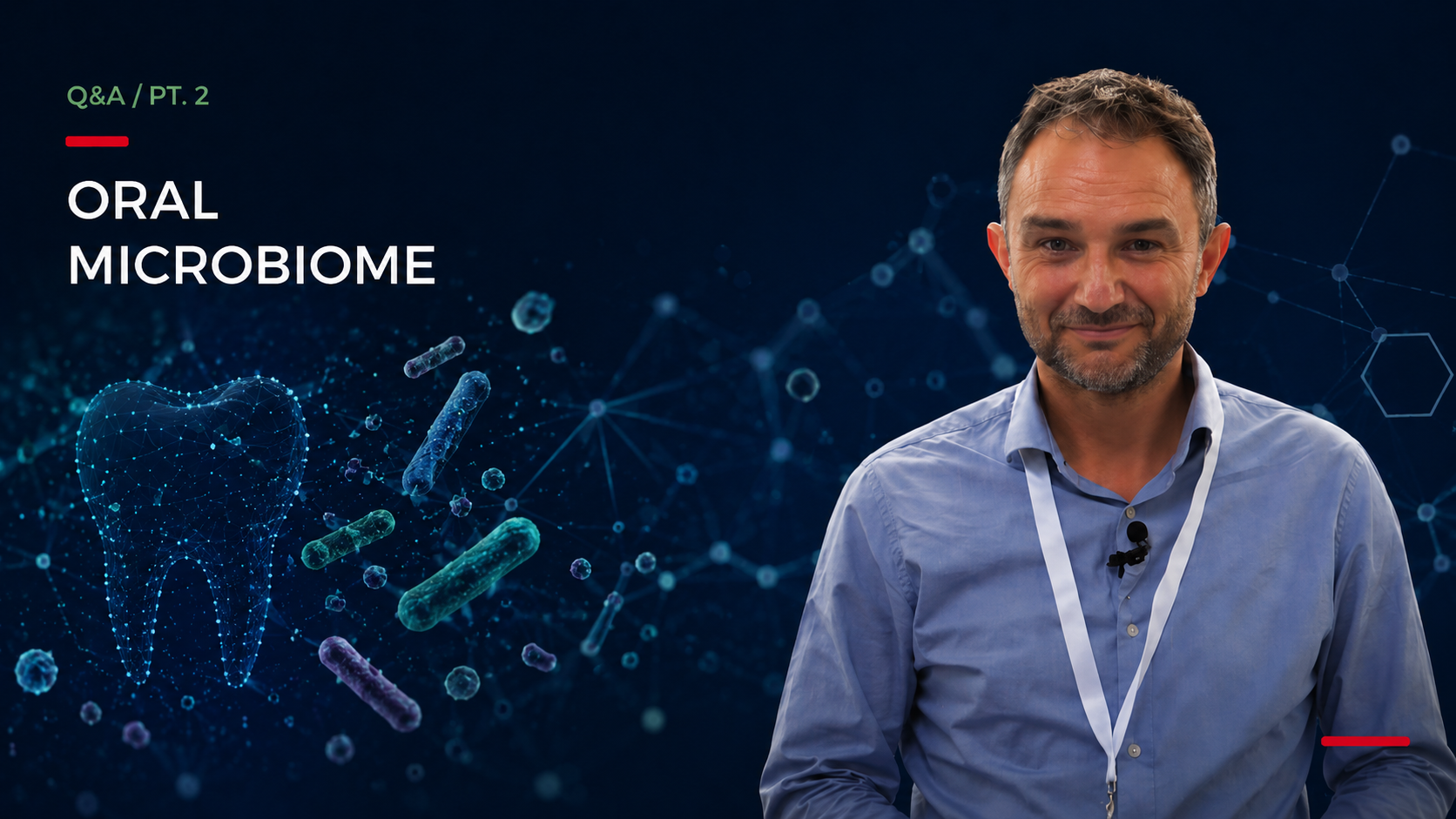
Alex Mira, PhD, is a senior researcher and Head of the Oral Microbiome Laboratory at the FISABIO Institute in Spain. In part 2 of this Q&A series, CSB’s Henry Haiser speaks with Dr. Mira about some of the challenges of integrating new bacteria into the oral microbiome and some potential therapeutic interventions. For informational purposes only; not medical advice.
HH: What are some of the possible interventions you’re seeing to improve oral microbiome health?
AM: One of the earliest interventions researchers explored was vaccines for dental caries using surface antigens of Streptococcus mutans as targets. However, we discovered that S. mutans represents a very small portion of the microbial community in cavities, so this approach did not work in most cases.
Even if we could find a way to make this intervention work, we would only be able to target around 1% of bacteria that cause oral cavities. The research community instead started investigating alternative approaches. The areas where we’ve seen most success are with prebiotics and probiotics.
HH: Can you explain more about what both of these are?
AM: To solve some of the most common oral microbiome challenges, we need to restore balance. Prebiotics and probiotics are two complementary approaches to achieve this. Prebiotics are substrates that act as fertilizer to foster the growth and development of beneficial bacteria. Probiotics add health-associated bacteria that perform beneficial functions.
HH: Are there any specific substrates or bacteria you have tried and seen success with?
AM: Yes. One example is nitrate, where we’ve already seen a lot of success. The other is ammonia, which neutralizes lactic acid. This organic acid lowers pH levels after a meal and is a direct contributor to tooth decay. By consuming lactic acid through ammonia, we can buffer pH drops.
HH: Let’s start with nitrate. What applications have you used here?
AM: We began by looking at some of the foods that cause active damage to oral health. For example, by adding nitrate to energy drinks with high sugar content, we can reduce acidogenicity. This has already shown promise in early clinical trials, and we believe it could also work with candy, although we haven’t tested this yet.
We’ve also been experimenting with oral care products in our artificial mouth model. Added nitrate can reduce dental plaque, leading to lower inflammation, acid production, and less volatile sulfur compounds that cause bad breath.
Finally, we are interested in adding nitrate to chewing gum. This could improve clinical outcomes by both buffering pH and providing an adjunctive treatment for gum disease.
HH: Fascinating. Have you conducted any other clinical trials using nitrate?
AM: We recently completed a study assessing whether dietary intervention can assist with the healing of the gingiva after periodontal treatment. Half the cohort received nitrate-rich vegetables for 70 days, and we’ve already seen big improvements in this group, including lower clinical attachment loss, lower periodontal pocket depth, lower bleeding, and reduced plaque growth. All that in addition to an improvement in blood pressure.
HH: Beyond nitrate, what other routes have you explored to improve oral health?
AM: One of the other areas of research we’re really excited about is bacteria-based probiotics. Over a decade ago, we conducted the first metagenomic study of dental plaque worldwide. We took dental plaque from caries-free and caries-active individuals, extracted the DNA, and sequenced the bacterial composition to see which bacteria are associated with good oral health.
We found high levels of Neisseria and Rothia, which at the time was surprising. Now we know that they consume nitrate. We also found a new Streptococcus species associated with oral health, which we named Streptococcus dentisani, Latin for “healthy teeth.”
In a later study, we were able to culture S. dentisani next to bacteria causing oral diseases, including S. mutans and S. sobrinus. We observed an inhibition ring around the S. dentisani, revealing it to be an anti-cavity organism. It was one of the most exciting moments in my career: caries-free individuals have healthy bacteria protecting them.
HH: I’d love to hear more about this anti-cavity research.
AM: Sure. We found that 10% of people without any cavities have good bacteria protecting their teeth. We discovered this by chance: a girl in our lab has never had cavities, but her boyfriend did. Since they started dating, he has developed fewer cavities. We realized he was receiving the good bacteria from kissing his girlfriend.
We have since tested this across multiple countries and found that people without cavities have higher levels of S. dentisani compared to those who have cavities. This led us to believe that we could use S. dentisani as a probiotic, developing cocktails to add to toothpaste or mouthwash that target specific bacteria.
In another study, we put S. dentisani into dental trays and applied it for 5 minutes on teeth. It lowered gum inflammation and improved pH and bacterial composition. We thought that, if we develop this commercially, it could be used by dentists or bought by consumers in a supermarket to promote oral health. In fact, a start-up company in California, named Evenmouth, has developed an S. dentisani toothpaste that will be launched in 2026.
HH: Have you encountered any challenges when developing prebiotics and probiotics?
AM: Yes, when we started clinical studies using gut bacteria, we weren’t able to achieve long-term binding and colonization. For example, we saw S. dentisani levels return to normal 2–4 weeks after administration. However, even after a return to baseline, we still saw clinical features continue to improve in the long-term. It’s possible we may only need short-term intervention without long-term colonization. Keeping bacteria alive in toothpaste is also a challenge.
HH: Thank you for answering our questions. Where can readers learn more about your work?
AM: There are several videos that walk through different aspects of our research. For a general audience, this video explains our artificial mouth model, which we use to test new oral care compounds. We’ve also developed self-propelled nanoparticles to fight biofilm infections, including applications in oral disease, and another project exploring nitrate as an oral prebiotic to prevent dysbiosis and conditions like periodontitis, halitosis, and dental caries. For professionals, this video explains the mechanics of how tooth decay takes place, and a recent lecture at the University of British Columbia covers some of the latest advances in the field. Readers who’d like to dig deeper can also find a full list of our publications here.
About Dr. Alex Mira
Alex Mira earned his doctorate in microbiology at Oxford University and conducted postdoctoral research in the USA and Sweden before establishing his research group in Spain in 2003. He is currently the principal investigator of the Oral Microbiome Laboratory at the FISABIO Foundation, where his team applies genomics and metagenomics to study the oral microbiome and its role in dental caries, periodontal disease, halitosis, and links to systemic conditions. He received the FIPSE National Award for Health Innovation for the discovery of Streptococcus dentisani, a probiotic isolated from caries-free individuals, and holds 12 patents in oral care. His current work focuses on novel oral prebiotics and probiotics, and he is leading the creation of a Saliva Biobank for early diagnosis of systemic diseases.
Follow Dr. Mira on Twitter/X: @mira_ale